Loss of the tumor suppressor PTEN frequently causes cancer cells to become dependent on the phosphoinositide 3-kinase beta (PI3Kβ) isoform, but the signaling mechanisms through which PI3Kβ promotes tumor-cell migration and invasion remain incompletely understood. This project will investigate whether lysophosphatidic acid (LPA) selectively activates PI3Kβ, rather than other class I PI3K isoforms, to promote migration in PTEN-deficient cancer cells and determine whether this response is mediated through the JNK-c-Jun/AP-1 signaling pathway. I will use pharmacologic inhibitors and genetic approaches to disrupt PI3Kβ and JNK signaling, wound-healing and transwell assays to measure cell migration and invasion, and Western blotting and quantitative PCR to evaluate pathway activation and downstream gene expression. This research may identify a previously underexplored signaling mechanism driving metastasis in PTEN-deficient cancers and provide evidence supporting combined PI3Kβ and JNK inhibition as a potential therapeutic strategy.
As far as what I’ve already completed, I have completed a wound healing and cell proliferation optimization experiment to find what concentrations of cells and concentrations of LPA induce the greatest growth period for PTEN-null control cancer cells with no PI3Kβ isoform knockouts.
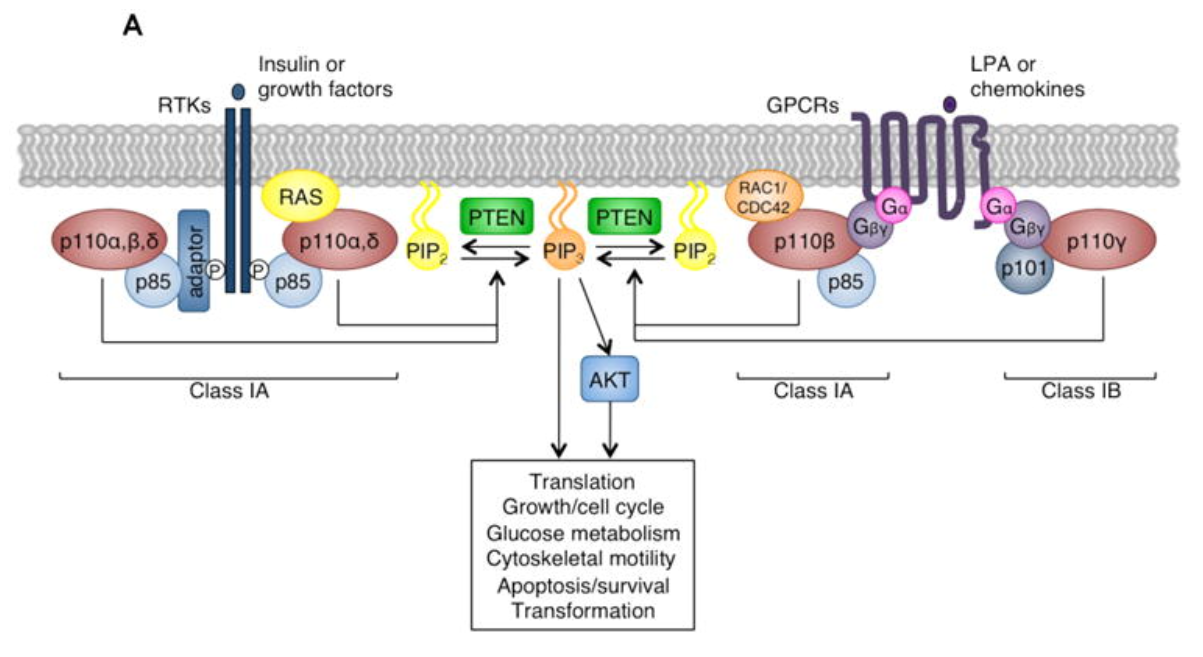
The image I included was a common one my mentor and I have discussed since my first day, and is a basic pathway demonstration.
Figure adapted from: Thorpe LM, Yuzugullu H, Zhao JJ. PI3K in cancer: divergent roles of isoforms, modes of activation and therapeutic targeting. Nature Reviews Cancer. 2015;15(1):7–24. doi:10.1038/nrc3860. Figure 2.