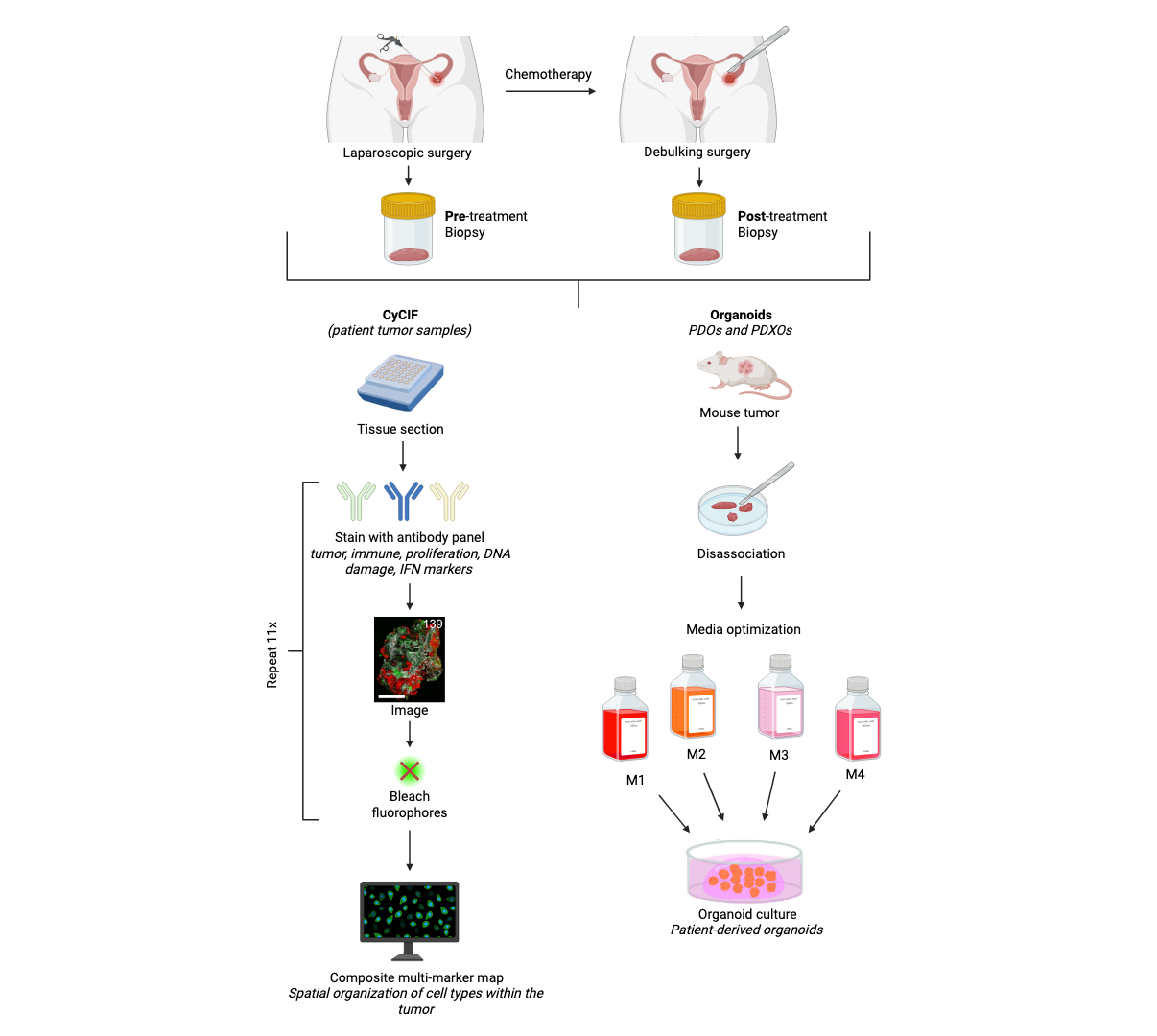
High-grade serous ovarian cancer (HGSOC) is the most aggressive subtype of epithelial ovarian cancer (EOC). Although ~70% of patients initially respond to first-line chemotherapy, most eventually develop recurrent, treatment-resistant disease driven by persister cells that survive treatment; understanding how these cells survive and identifying strategies to eliminate them is critical to improving patient outcomes. Our lab’s analysis of paired pre- and post-treatment HGSOC tumor samples has identified enrichment of interferon (IFN)-pathway signaling in cells that persist after chemotherapy, suggesting this pathway may drive therapy resistance. Traditional 2D HGSOC cell lines are poorly suited to studying this phenomenon because they fail to capture the cellular heterogeneity present in real tumors. My project will address this by establishing and optimizing patient-derived organoid (PDO) and patient-derived xenograft organoid (PDXO) models of HGSOC, beginning with a review of the literature to identify growth media conditions that allow these organoids to expand while faithfully recapitulating the heterogeneity of the original tissue. This will involve implanting patient tumor samples into mice to generate xenografts, establishing three-dimensional organoid cultures from this tissue, and testing and refining growth media to support them. Additionally, to characterize pathways associated with treatment resistance in human samples, I will help expand our lab’s collection of paired pre- and post-treatment patient tumor samples for analysis by cyclic immunofluorescence (CyCIF), a multiplex imaging technique that images dozens of markers on the same tissue section across sequential staining cycles—including markers of tumor cells, immune populations, proliferation, DNA damage, and interferon signaling—to more closely examine how tumors and their surrounding microenvironment change in response to treatment. Together, this project aims to establish models that better capture and define tumor heterogeneity than 2D cell lines, creating a more physiologically relevant platform to investigate whether interferon signaling drives drug resistance in HGSOC and providing a foundation for future studies aimed at identifying strategies to eliminate treatment-persistent tumor cells.