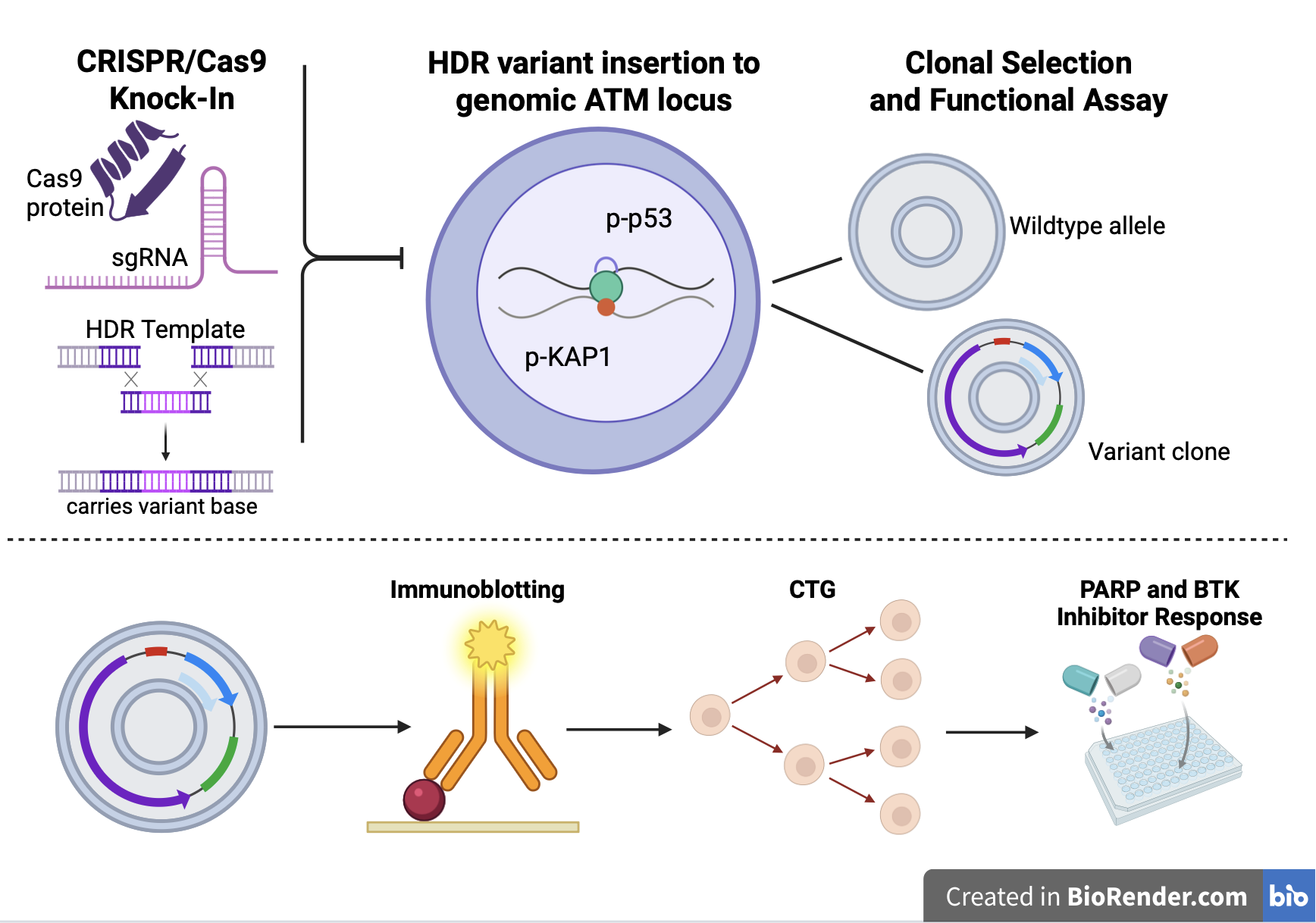
The role germline genetic variation plays in the risk of developing cancer, specifically for malignancies like Chronic Lymphocytic Leukemia (CLL) that do not have a clear Mendelian inheritance pattern, remains to be fully elucidated. Previous work from the Brown Lab at Dana-Farber Cancer Institute demonstrated that rare germline variants of unknown significance (VUS) in ATM, a DNA-damage response gene, are significantly enriched in patients with CLL in comparison to the non-hematological and other hematologic malignancies. However, while next-generation sequencing frequently identifies these missense VUS, they are often filtered out during standard variant calling processes despite their potential pathogenicity. Specifically, this work demonstrated that VUS variant ATM p.L2307F was the most enriched variant in the CLL population. Patients harboring these rare germline ATM variants exhibit distinct clinical characteristics, including a younger age at diagnosis and a significantly higher incidence of somatic 11q deletion. Furthermore, biallelic ATMdysfunction is associated with an aggressive disease course and a significantly worse prognosis. These clinical and functional findings establish the variant as a functionally hypomorphic allele as opposed to a benign polymorphism and stresses the idea that many variants classified to be of “uncertain significance” may contribute mechanistically to CLL pathogenesis by partial loss or tumor-suppressor function. With this research as a backbone, the lab is now generating additional knock-in CRISPR cell lines to consider other germline variants as candidates and to examine the downstream cellular signals affected by these disruptions. My research project will utilize CRISPR/Cas9-mediated homology-directed repair to introduce specific variants into their endogenous genomic loci, followed immediately by Sanger sequencing to confirm successful knock-in. Subsequently, I will perform comprehensive downstream functional assays to evaluate the specific malfunctions caused by these ATMvariants. This will include immunoblotting to assess DNA-damage response target activation, flow cytometry for cell cycle and apoptosis profiling, and CellTiter-Glo (CTG) assays to measure cellular proliferation. Furthermore, to determine the translational relevance of these mutations, I will conduct drug sensitivity assays utilizing targeted agents such as PARP and BTK inhibitors. Through this work we can better clarify the functional significance of these variants and expand understanding of the ways genetic variation can shape development and clinical behavior of Chronic Lymphocytic Leukemia.